Applying Smart Algorithms for Intelligent DLP & Data Protection Data loss prevention (DLP) and Data Protection programs play a vital role in an organization’s information security strategy. DLP is essential for tracking a company’s volume of data and organizing it … Read More
data loss prevention
Insider Threats, preventing data exfiltration
The digital economy is undergoing remarkable transformation and security is being compelled to evolve as organizations embrace services that are more dynamic in nature. The things organizations do to grow, innovate, and drive performance change the cyber risk landscape every day.
Business leaders today are realizing that the digitalization is fundamentally enabling sharing of information across a multitude of platforms, not necessarily protecting it. They recognize that they are essentially at the mercy of their own employees and third parties associated with them to handle crucial business sensitive information.
On the other hand, cyber security incidents, including breach and disclosure of intellectual property, customer data, other sensitive data (e.g., GDPR, PII, PHI, PCI), are increasingly pervasive in today’s business environment. Data is one of a organization’s most vital asset and the cyber risks associated with data is crucial for any organization. According to a 2017 Insider Threat Report, out of all the potential cyber threats in the wild, insider threats is one of the most prevalent threats and associated incidents have risen due to economic conditions and insider access accorded to non-approved third parties.
So, fundamentally who is an insider threat? Any employee who has the potential to harm an organization for which they have inside knowledge or access. The past several years have seen some of the history’s most high-profile data breaches. The extent of data loss across the organization is incrementing year by year and so are the associated challenges in protecting the data.
The Ponemon Institute’s 2017 Cost of a Data Breach study estimates that in the US, the cost per record of a data breach is $201 per record (including many factors, direct and indirect). Those costs jump to $215 per record in the case of malicious attacks, or incident involving third parties. Obviously, this can add up to hundreds of thousands, or millions, depending on the amount of sensitive data involved.
But what the various cost analyses of cyber incidents don’t take into account is that malicious attacks are increasingly aimed not at the theft of sensitive data, but the serious disruption of operations, the elimination of data, or theft of intellectual property or information that can permanently impact market share and competitive advantage.
Recent attacks demonstrate that we need to change the game
There are multiple types of insider incidents seen across industries. The GTB perspective is that organizations cannot succumb to thinking of themselves as passive victims of cyber crime. However, we need to take stock of the fact that, it is our own relentless leveraging of technology, which create gaps that cyber criminals exploit.
To manage the risks arising from internal threats from a cyber risk perspective, though, means that it has to be taken on as a business problem. Executives do not need to suddenly become cyber security experts, but need to lead the discussion with an emphasis on:
- Focus on risk mitigation versus compliance requirements: Many organizations are heavily focused on addressing audit and regulatory findings, but the solutions implemented often do not help reduce risk and address threats that the company faces.
- Build and maintain a comprehensive inventory of sensitive assets and data: Many organizations don’t know where their data is. It’s very difficult to appropriately protect data if you don’t know where it is collected, stored, used, and transferred both inside and outside the organization.
- Focus on implementing solutions to protect data and monitor for data loss at the “data layer”: Many organizations are not effectively implementing critical capabilities such as Data Loss Protection (DLP) solutions, encryption and database activity monitoring, among others. Building the capability to monitor systems, applications, people, and the outside environment to detect incidents more effectively.
- Consistently execute the security fundamentals: Many organizations are still not consistently executing fundamental data protection capabilities (e.g., patching, privileged access, asset management), which leaves sensitive data even more vulnerable.
This may require more investment, but it may also simply entail a new approach. The crux of that approach is to recognize that managing cyber risk must be an inherent aspect of growth and innovation strategies. The two cannot be separated.
How secure is your data? Do you REALLY know? Find out now
GTB’S Vision for the DLP Data Protection Space
From a philosophical standpoint, the main difference between GTB DLP and the others is policymaking.
Good Data Protection / DLP Policy making has many ingredients.
First, is the classification of data. Then, the ability to detect that data followed by policy making. Finally, enforcement of those policies.
The problem for most DLP solutions has to do with the implementation of the DLP methodology or what we call “DLP Vision”.
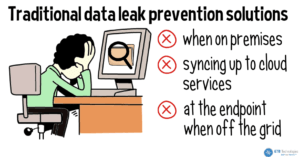
What other solutions focus on
Detection: Other “leading ” DLP vendors focus on detection of content using imprecise detection methods. Imprecise detection (regular expressions, keyword matching, tagging, Machine Learning, etc) are a major cause for DLP failures. These detection techniques cause an unmanageable amount of false positives, thus require “tuning”, the achilles heel for DLP solutions. Only precise detection (content registration or fingerprinting) will yield virtually zero false positive rates. Other DLP solutions can’t perform fingerprinting without “choking”.
Policy: Other solutions also focus on policy making for what’s allowed, what’s not allowed, what are the sources and variables of data, etc. There are just so many policy options and inputs these DLP systems with the described vision can handle, especially with large organizations encompassing thousands of end users. To visualize this, take the following example, most DLP solutions will need to develop a policy for EACH specific user, in order to send certain amounts or types of data to a specific destination.
Enforcement: This requires thousands of polices! One can get lost within the jungle of polices. Because this approach requires customers to create polices for EACH user, there are repercussions for a large enterprise such as false-positives, expensive “tuning“, and network degradation. All are costly and unproductive creating more problems than solving.
[spacer]
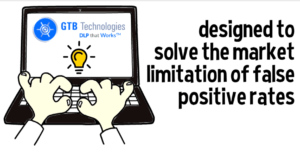
GTB Technologies DLP that WorksTM platform is geared to revolutionize this poor vision for the DLP space.
The Data Loss Prevention vision of GTB is focused on deploying policies, utilizing precise detection methods, with our patented, proprietary content-aware-reverse-firewall with AccuMatch technology. Just like a firewall, GTB policy making is focused on the exceptions to the rules rather than what is allowed or disallowed for each specific user. GTB created this technology along with its detection engines to insure that each DLP event is a valid and noteworthy event for efficient workflow.
GTB customers do not need to insert thousand of policies, for a specific user or user groups. Instead, they can gain network visibility throughout their entire environment via a firewall process creating objects and administering rules on the objects. This deductive methodology allows for simple policy making and enforcement all in a firewall format.
Data Protection outside the network
Furthermore adding to its’ data extrusion protection methods, GTB DLP offers organizations the ability to place policies on specific files and / or data that are outside their environment.
The above capabilities are some of the many reasons why GTB prides itself in providing true data protection to its’ customers, a data protection solution that works.

GTB Technologies Positioned Furthest for Completeness of Vision in the Visionary Quadrant of Gartner’s Magic Quadrant for Enterprise Data Loss Prevention
5 time Visionary , GTB Technologies positioned furthest for Completeness of Vision, strengths noted as: “ ■ GTB’s combination of data fingerprinting, OCR and native SSL decryption provides powerful interception capabilities, particularly for intellectual property protection use cases ■ … Read More